
How Far Can a Character Express Itself?
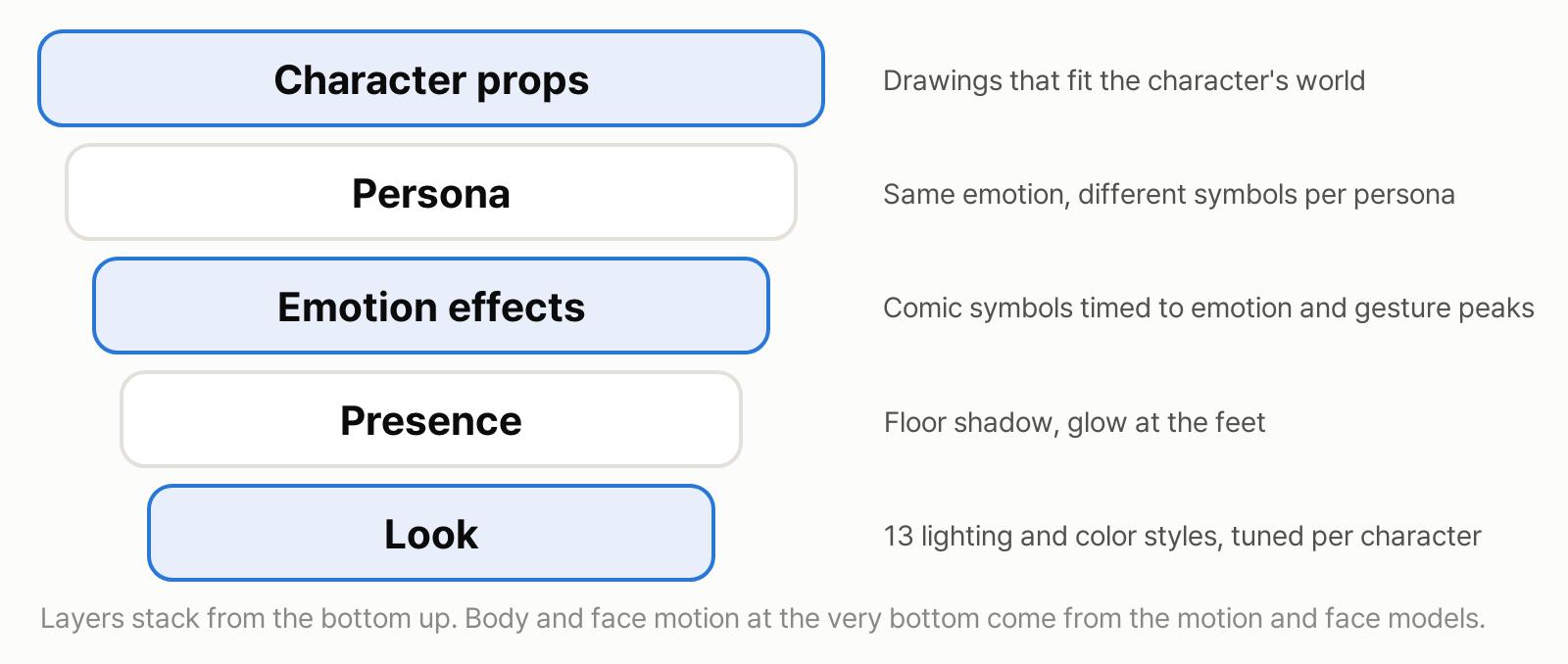
Motion and a face make a character move. Light, presence, a sparkle at the right moment and a reaction that fits its personality make it feel alive. Here are the layers we stack on top, and how far they reach today.
The look
A shader decides how a 3D surface catches light. On top of an anime-style shader we built 13 looks, each a bundle of lighting, color grading, rim light and glow, from a rose halo to a neon alley to moonlit cel shading. Skin, face, hair, clothes and eyes are shaded separately, face shadows are shaped per character, and eyes show through the hair. On an iPhone 13 Pro at maximum zoom the look runs at 30 fps, the download is about a third of its earlier size, and the character appears only once its shaders are ready, so nothing flickers on load.
Presence
Characters float when there is no shadow under them. We draw the real shadow of the key light on the floor, plus a soft pool of light under the feet on dark backgrounds. It reuses light information we already compute, so the phone frame rate barely moves (30.1 vs 29.9 fps).
Emotion you can see
Manga symbols around the head (sparkles and notes for joy, an anger mark, a sweat drop, gloom lines) follow the emotion and strength (1–5) of each line the character speaks. Strength 1–2 changes only the face, 3 adds a small mark, 4–5 a full symbol; a new big symbol appears only when the emotion changes and at most once every 7 seconds, and effects shrink while the character is talking.
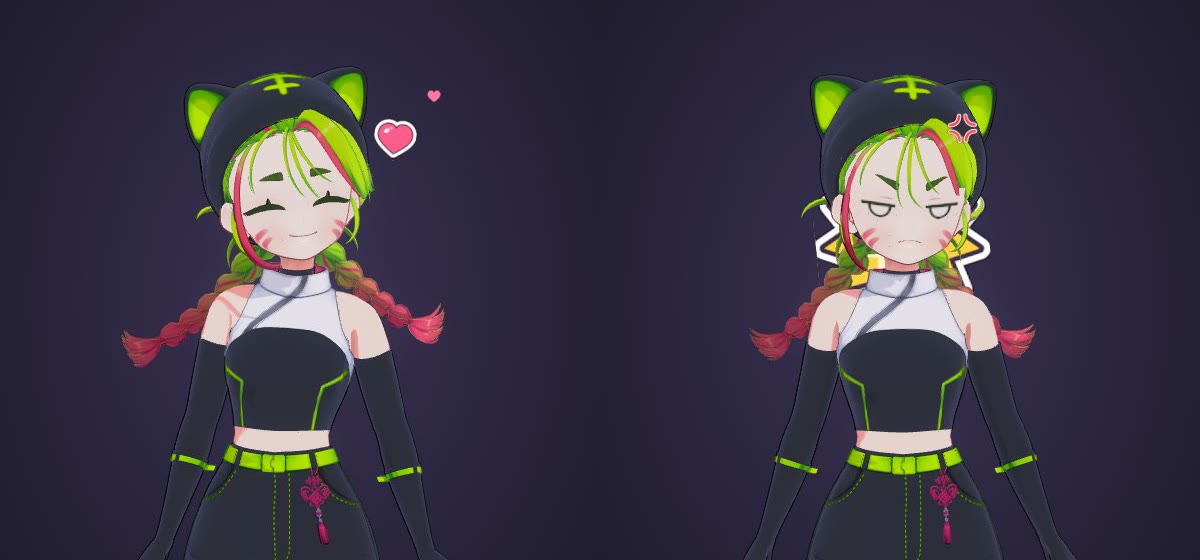
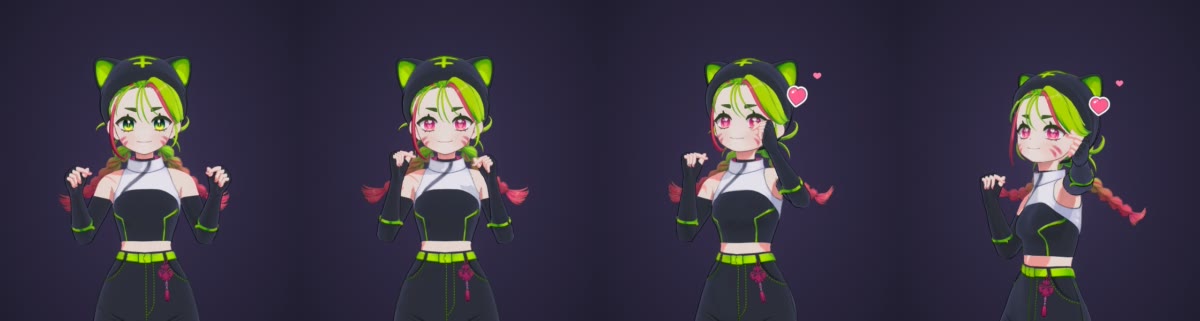
Gestures get effects too, timed to their peak: the moment two hands meet in a heart, the fastest point of a wave, the deepest point of a bow. A waving hand leaves one soft see-through trail, and the phone holds 60 fps.
Personality in every reaction
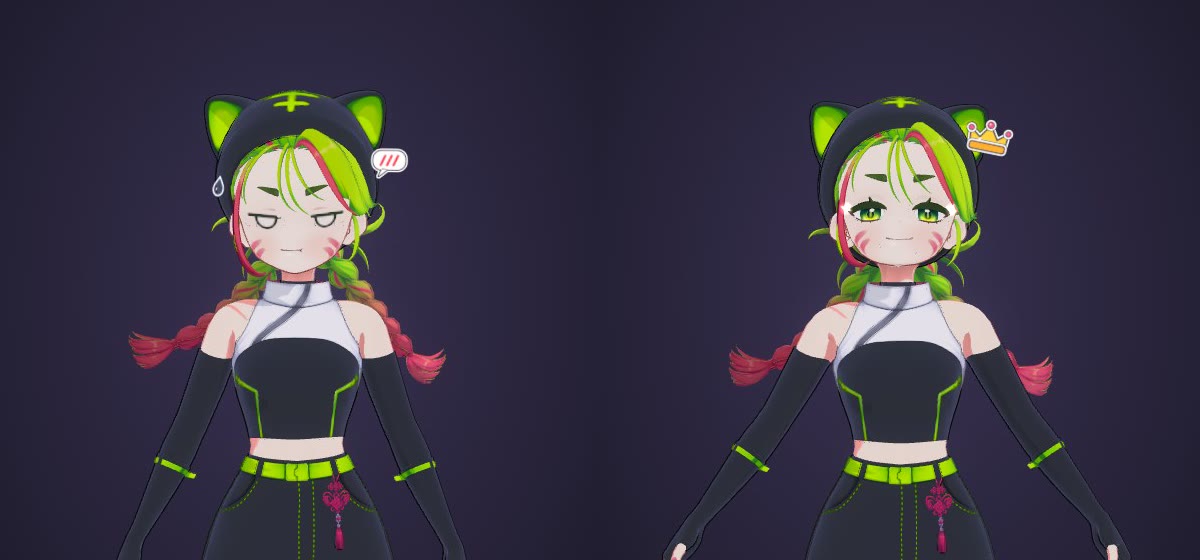
Our service has four personas: tsundere (prickly outside, warm inside), hime (princess-like), onee (big-sister), deredere (openly affectionate). The same emotion gets a different symbol, frequency and entrance (pop, flash or a soft fade) for each: a tsundere's "hmph" puff, a hime's crown and folding fan, an onee's sigh.
Every character, its own world
Effects are drawn in each character's own style: a secretary agrees with a drawn check mark and petals, an idol trainee with a lightstick, mic and fan letters, a forest ranger with a little flag, leaves and a baby moon bear, a quiet night-themed character with stars and a moon instead of hearts, and the fewest reactions of all. We reviewed every one of the 20 character × persona combinations across 1,072 captured frames.
Tools for artists
A web tool lets artists drop a texture painted on an iPad onto the 3D character and see it immediately under any of the 13 looks. The files never leave the device.
Where we are today
Because each layer is independent, a new character only needs its own drawing style to use all of it.