
From Performance to Any Character: The Data Behind Our Motion
Great generated motion starts with great motion data. Here is how one real performance becomes clean animation on many different characters, hands resting on each body instead of sinking into it.
A motion model learns everything in its data, including the flaws: hands sinking into the waist, feet sliding across the floor, a head clipping through raised arms. Every one of those comes back in generated motion. So before we teach our characters anything, we make sure the motion they learn from is clean on the exact characters it will drive.
From the studio to the character
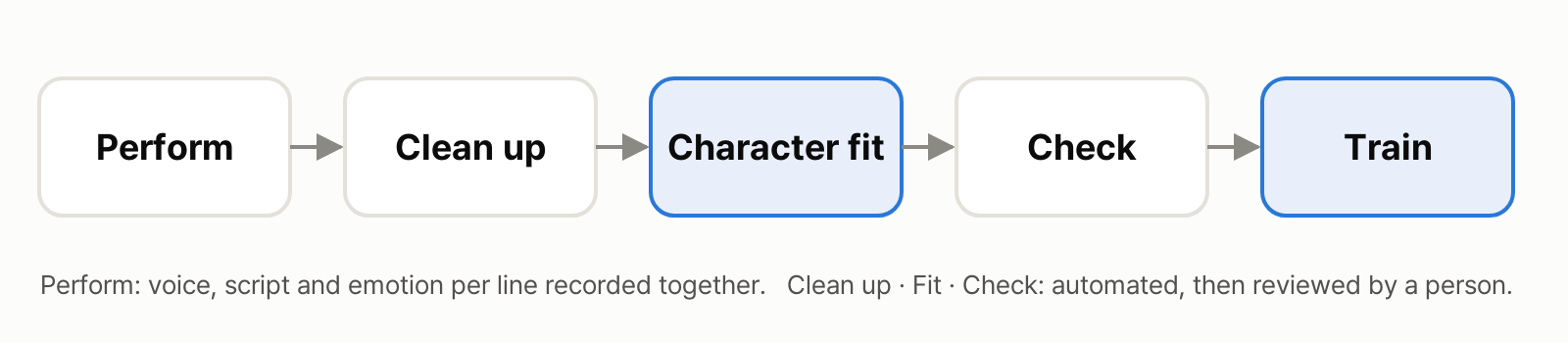
Perform
Actors perform each character in a motion capture studio. Every performance is recorded together with the voice and the script, and every line is labeled with one of 16 emotions, so our models can learn how a character moves when it is shy, sulking or excited.
Clean up, automatically
Our own software turns raw capture into animation: noise smoothed, hands meeting the face and each other exactly where they should. A clip that used to take minutes now takes seconds, with results identical to the versions we had already approved.
One performance, many bodies
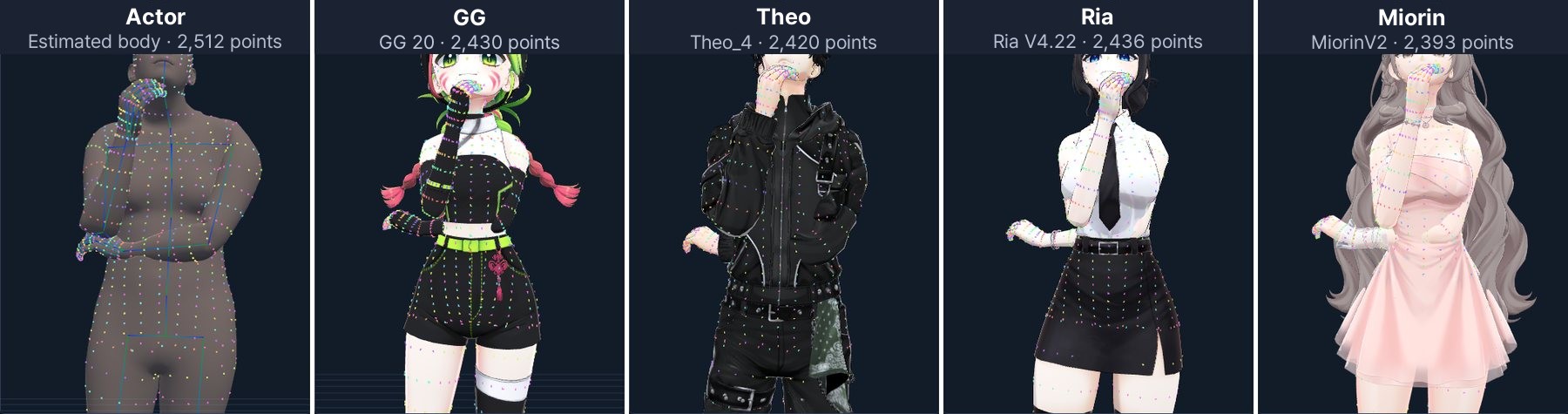
Retargeting copies joint angles from an actor to a character with different bone lengths. It knows nothing about the body's surface, so a hand resting on the actor's waist ends up inside a character whose outfit is bulkier. We do something different: we mark about 2,400 matching points on the actor's body and on every character's body, and carry over relationships ("the palm touches the corner of the mouth") rather than angles.
The difference is easiest to see with hands on hips. In Figure 3 the top row is plain retargeting, the bottom row is our pipeline, same frame of the same idle clip.
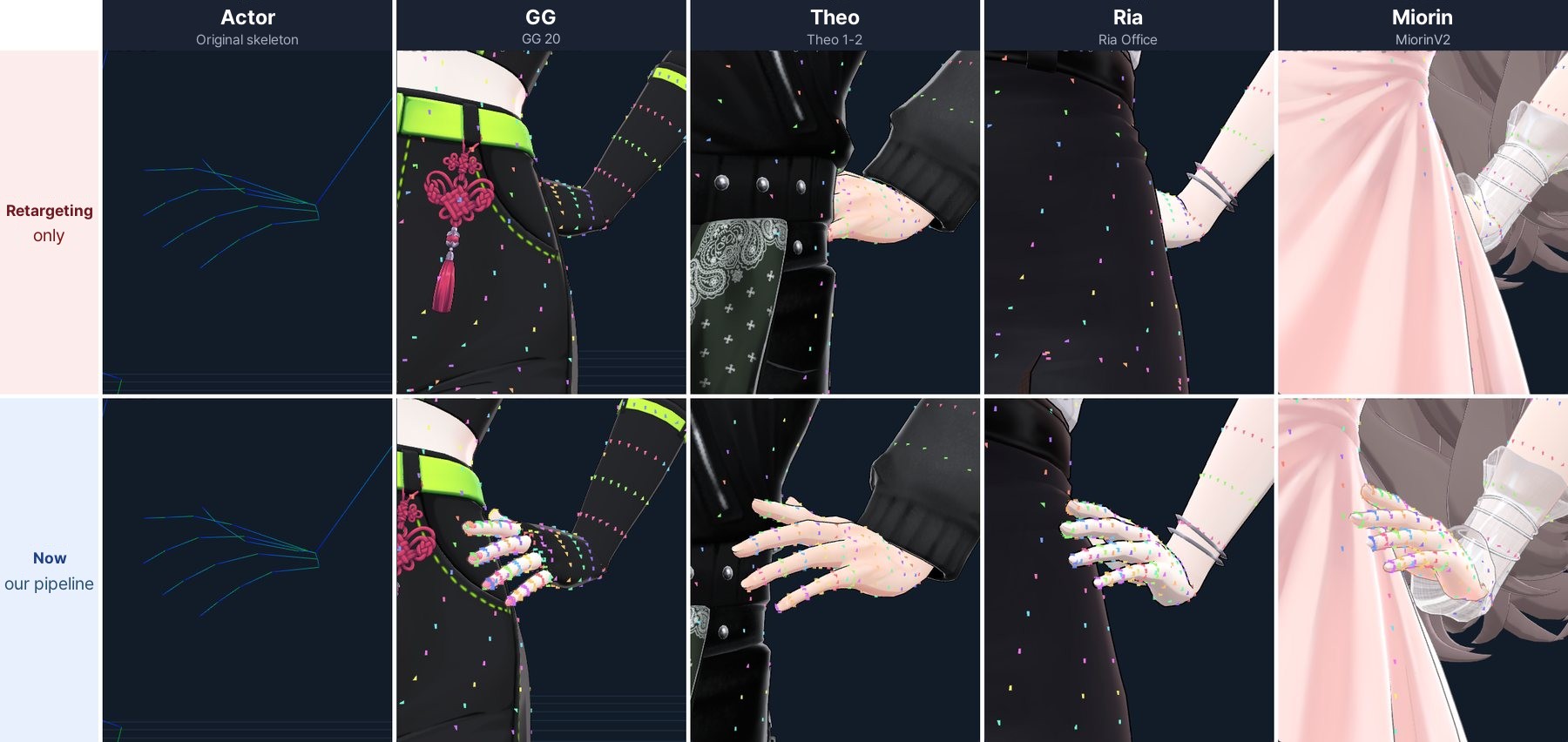
- On one character, frames where the hand or forearm crossed the body or clothes went from 240 to 0 (324-frame idle clip).
- Across four characters, crossing surface pairs dropped 89–100% on the same clip.
- Solving each clip's arm motion as a whole, instead of stacking one fix after another, cut penetrating frames on our eight hardest clips from 8,853 to 139 (−98%).
One piece of software serves every character; only the character's model file and a small settings bundle change, and penetration is measured on the character's real surface.
Across the whole library
We re-processed our library this way and compared every clip with the earlier version:
| Glitch frames across the library | Before | After | Change |
|---|---|---|---|
| Arm through body | 176,175 | 6,814 | −96% |
| Head clipping through arms | 129,558 | 1,265 | −99% |
| Foot problems | 15,422 | 445 | −97% |
| Leg through leg | 5,203 | 68 | −99% |
| Sinking into the floor | 39,532 | 0 | −100% |
A clip is only replaced when nothing about it gets worse; otherwise the earlier version stays.
Feet on the floor
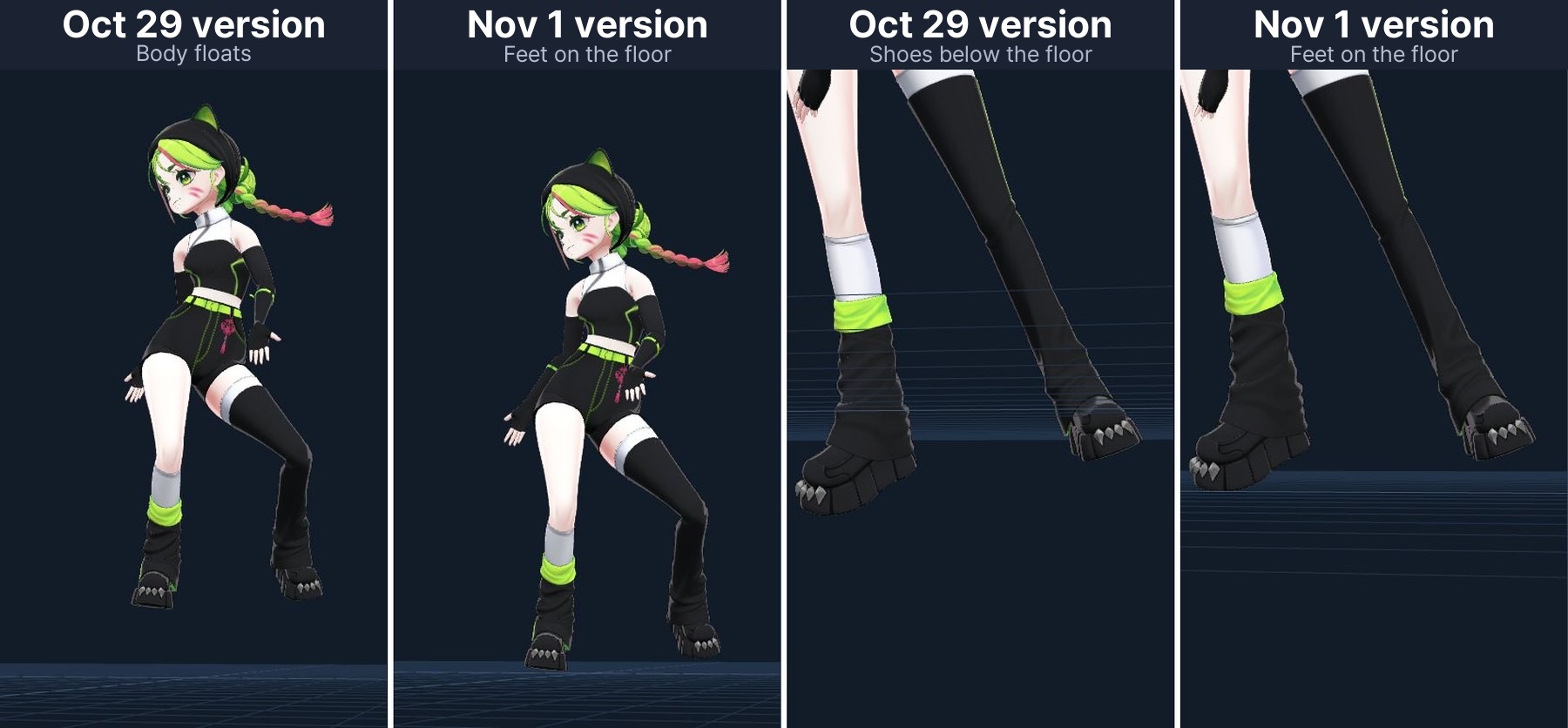
Across our special-motion set, frames with a shoe more than 10 mm below the floor fell from 5,145 to 9. On one clip, the speed of the planted ankle (90th percentile) fell from 18.3 to 1.5 cm/s, close to the actor's own 1.9 cm/s.
Check
Automatic checks run on every clip, and a person reviews the result before it is used. Fixes are tied to the performances that motivated them and re-tested whenever anything changes.
Why it matters
- Quality in, quality out. We believe clean data is one reason our generated characters clip through themselves less often (see Persona Motion).
- New characters cost little to add. A new character body can reuse every performance we already have.
- The library compounds. Every performance, with its voice, script and mood, can drive every current and future character.